
SAFETY
SAFETY TRAINING
ATV safety training is a top priority for POLARIS. POLARIS strongly encourages you and any family members who will be riding the ATV to take a training course.
A POLARIS ATV is an off-road vehicle. Familiarize yourself with all laws and regulations concerning the operation of this vehicle in your area. We strongly advise you to strictly follow the recommended maintenance program outlined in your vehicle manual. This preventive maintenance program is designed to ensure that all critical components on your vehicle are thoroughly inspected at specific intervals.
SAFE RIDING GEAR
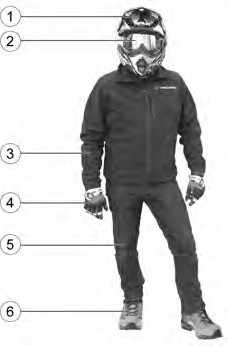 Always wear helmet, eye protection, gloves, long-sleeve shirt, long pants, and over-the-ankle boots at all times. Protective gear reduces the chance of injury.
q Helmet
w Eye Protection e Long Sleeves r Gloves
t Long Pants
y Over-the-Ankle Boots
HELMET
Wearing a helmet can prevent a severe head injury. Whenever riding this POLARIS vehicle, always wear a helmet that meets or exceeds established safety standards. Clasp the buckle and pull each strap tight to ensure the helmet is properly secured to the head.
 Approved helmets in the USA and Canada bear a
U.S. Department of Transportation (DOT) label.
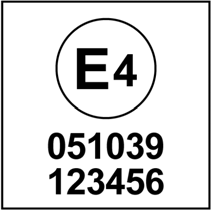 Approved helmets in Europe, Asia and Oceania bear the ECE 22.05 label. The ECE mark consists of a circle surrounding the letter E, followed by the distinguishing number of the country which has granted approval. The approval number and serial number will also be displayed on the label.
EYE PROTECTION
Do not depend on eyeglasses or sunglasses for eye protection. Whenever riding this POLARIS vehicle, always wear shatterproof goggles or use a shatterproof helmet face shield. POLARIS recommends wearing approved Personal Protective Equipment (PPE) bearing markings such as VESC 8, V-8, Z87.1, or CE. Make sure protective eye wear is kept clean.
GLOVES
Wear gloves for comfort and for protection from sun, cold weather and other elements.
BOOTS
Wear sturdy over-the-ankle boots for support and protection. Never ride a POLARIS vehicle with bare feet or sandals.
CLOTHING
Wear long sleeves and long pants to protect arms and legs.
SAFETY WARNINGS

Failure to operate this vehicle properly can result in a collision, loss of control, accident or rollover, which may result in serious injury or death. Heed all safety warnings outlined in this section of the owner’s manual. See the operation section of this owner’s manual for proper operating procedures.
WARNING
OPERATING WITHOUT INSTRUCTION
 Operating this ATV without proper instruction increases the risk of an accident. The operator must understand how to operate the ATV properly in different situations and on different types of terrain.
Beginning and inexperienced operators should complete the recommended safety training before operating this vehicle.
Never permit a guest to operate the ATV unless the guest has read this manual and all product labels and has completed a certified safety training course.
AGE RESTRICTIONS
 This vehicle is an ADULT VEHICLE ONLY. Operation is prohibited for anyone under 16 years of age.
Never allow anyone under 12 years of age to ride as a passenger on a 2-up ATV.
Even though a child may be within the recommended age group for operating some ATVs, they may not have the skills, abilities, or judgment needed to operate or ride on this ATV safely and could be susceptible to accident or injury.
USING ALCOHOL OR DRUGS
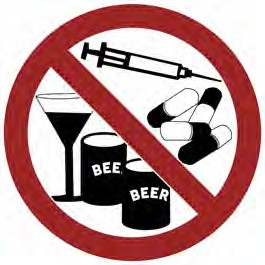 Never consume alcohol or drugs before or while operating this vehicle.
Operating this vehicle after consuming alcohol or drugs could adversely affect operator judgment, reaction time, balance and perception.
CARRYING MORE THAN ONE PASSENGER ON A 2-UP ATV
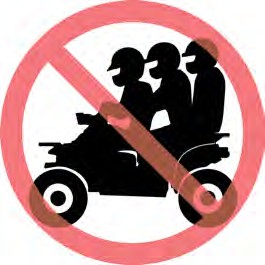 Carrying more than one passenger on a 2-up ATV greatly reduces the operator’s ability to balance and control the ATV, which may result in an accident or rollover. Never carry more than one passenger on a 2-up ATV.
FAILURE TO INSPECT BEFORE OPERATING

Failure to inspect and verify that the vehicle is in safe operating condition before operating increases the risk of an accident.
Always perform the pre-ride inspection before each use of your vehicle to make sure it’s in safe operating condition.
Always follow the inspection and maintenance procedures and schedules described in this owner’s manual.
WARNING
HANDLING GASOLINE
Gasoline is highly flammable and explosive under certain conditions.
- Always exercise extreme caution whenever handling gasoline.
- Always refuel with the engine stopped, and outdoors or in a well ventilated area.
- Never carry fuel or other flammable liquids on this vehicle. Failure to follow this instruction could lead to serious burn injuries or death.
- Do not smoke or allow open flames or sparks in or near the area where refueling is performed or where gasoline is stored.
- Do not overfill the tank. Do not fill the tank neck.
- If gasoline spills on your skin or clothing, immediately wash it off with soap and water and change clothing.
EXPOSURE TO EXHAUST

Engine exhaust fumes are poisonous and can cause loss of consciousness or death in a short time. Never start the engine or let it run in an enclosed area.
Operate this vehicle only outdoors or in well-ventilated areas.
CAUTION
PROTECTIVE APPAREL
 Riding in this vehicle without wearing an approved helmet and protective eye wear increases the risk of a serious injuries in the event of an accident.
Always wear a helmet, eye protection, gloves, long-sleeve shirt, long pants and over-the-ankle boots.
OPERATING ON PAVEMENT
This vehicle’s tires are designed for off-road use only, not for use on pavement. Operating this vehicle on paved surfaces (including sidewalks, paths, parking lots and driveways) may adversely affect the handling of the vehicle and may increase the risk of loss of control and accident or rollover. Avoid operating the vehicle on pavement. If it’s unavoidable, travel slowly, travel short distances and avoid sudden turns or stops.
OPERATING ON PUBLIC ROADS
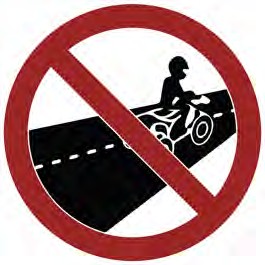 Operating this vehicle on public streets, roads or highways could result in a collision with another vehicle. Never operate this vehicle on any public street, road or highway, including dirt and gravel roads (unless designated for off-highway use).
OPERATING AT EXCESSIVE SPEEDS
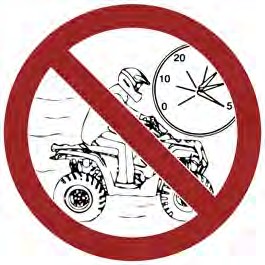 Operating this vehicle at excessive speeds increases the operator’s risk of losing control. Always operate at a speed that’s appropriate for the terrain, the visibility and operating conditions and your skills and experience.
PHYSICAL CONTROL OF THE VEHICLE
Removing even one hand or foot can reduce ability to control the vehicle or could cause loss of balance and ejection from the ATV.
If a person’s feet are not firmly planted on the footrests, they could come into contact with the wheels or other moving parts and lead to accident or injury.
Always keep both hands on the handlebars and both feet on the footrests of the ATV during operation.
TURNING IMPROPERLY

Turning improperly could cause loss of traction, loss of control, accident or rollover. Always follow proper procedures for turning as described in this owner’s manual.
CAUTION
Avoid sharp turns. Never turn while applying heavy throttle. Never make abrupt steering maneuvers. Practice turning at slow speeds before attempting to turn at faster speeds.
JUMPS AND STUNTS
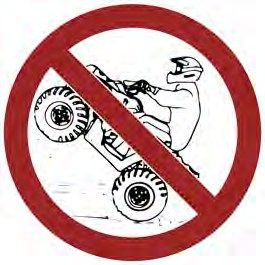 Exhibition driving increases the risk of an accident or rollover. DO NOT do power slides, “donuts”, jumps or other driving stunts. Avoid exhibition driving.
IMPROPER HILL CLIMBING
Improper hill climbing could cause loss of control or rollover. Use extreme caution when operating on hills. Always follow proper procedures for hill climbing as described in this owner’s manual. See the New Operator Driving Procedures section for details.
DESCENDING HILLS IMPROPERLY
Improperly descending a hill could cause loss of control or rollover. Always follow proper procedures for traveling down hills as described in this owner’s manual. See the New Operator Driving Procedures section for details.
CROSSING HILLSIDES
Driving on a sidehill is not recommended. Improper procedure could cause loss of control or rollover. Avoid crossing the side of any hill unless absolutely necessary.
If crossing a hillside is unavoidable, always follow proper procedures as described in this owner’s manual. See the New Operator Driving Procedures section for details.
STALLING WHILE CLIMBING A HILL
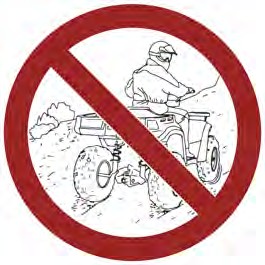 Stalling, rolling backwards or improperly dismounting while climbing a hill could cause a rollover.
- Always maintain a steady speed when climbing a hill.
- Always engage ADC mode (if equipped) before ascending or descending a hill. If ADC mode is not equipped, apply AWD mode before ascending or descending a hill.
If all forward speed is lost:
- Lean forward to keep body weight uphill. A passenger should also lean uphill.
- Apply the brakes.
- Lock the temporary brake lock when fully stopped.
- Dismount on the uphill side of the vehicle, or on the left if the vehicle is pointing straight uphill. Have a passenger dismount first, then the operator may dismount.
- Turn the ATV around and remount, following the procedure described in the owner’s manual.
If the ATV begins rolling downhill:
- Keep operator and passenger body weight uphill.
- Never apply engine power.
- Apply the brake lever gradually.
- When fully stopped, apply the auxiliary brake as well, and then lock the temporary brake lock.
- Dismount on the uphill side of the vehicle, or on the left if the vehicle is pointing straight uphill. Have a passenger dismount first, then the operator may dismount.
- Turn the ATV around and remount, following the procedure described in the owner’s manual.
OPERATING ON STEEP HILLS
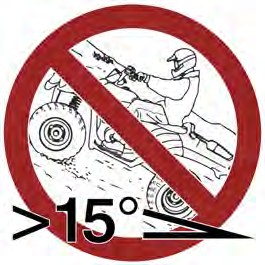 Operating on excessively steep hills could cause an overturn.
Never operate on hills too steep for the ATV or for your abilities.
Never operate this ATV on hills steeper than 15 degrees.
OPERATING ON SLIPPERY TERRAIN
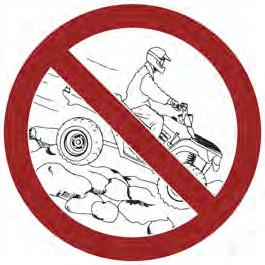 Failure to use extra caution when operating on excessively rough, slippery or loose terrain could cause loss of traction, loss of control, accident or overturn.
Do not operate on excessively rough, slippery or loose terrain until you’ve learned and practiced the skills necessary to control the vehicle on such terrain.
Always use extra caution on rough, slippery or loose terrain.
OPERATING IN UNFAMILIAR TERRAIN
Failure to use extra caution when operating on unfamiliar terrain could result in an accident or rollover.
Unfamiliar terrain may contain hidden rocks, bumps, or holes that could cause loss of control or rollover.
Travel slowly and use extra caution when operating on unfamiliar terrain. Always be alert to changing terrain conditions.
IMPROPER TIRE MAINTENANCE
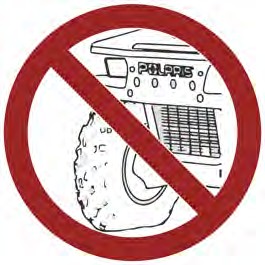 Operating this vehicle with improper tires or with improper or uneven tire pressure could cause loss of control or accident.
Always use the size and type of tires specified for your vehicle.
Always maintain proper tire pressure as described in the owner’s manual and on safety labels.
OPERATING IMPROPERLY IN REVERSE
Improperly operating in reverse could result in a collision with an obstacle or person. Always follow proper operating procedures as outlined in this manual. See the New Operator Driving Procedures section for details.
Before shifting into reverse gear, always check for obstacles or people behind the vehicle. When it’s safe to proceed, back slowly.
OPERATING OVER OBSTACLES
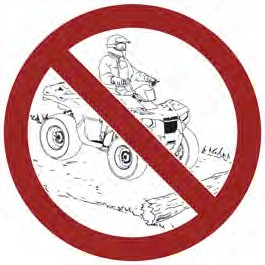 Improperly operating over obstacles could cause loss of control or rollover.
Before operating in a new area, check for obstacles. Avoid operating over large obstacles such as large rocks and fallen trees. Always follow the proper procedures outlined in this manual when operating over obstacles. See the New Operator Driving Procedures section for details.
SKIDDING OR SLIDING
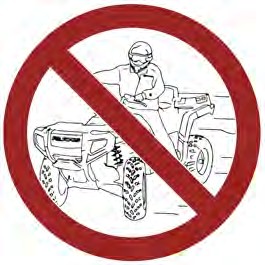 Failure to use extra caution when operating on excessively rough, slippery or loose terrain could cause loss of traction, loss of control, accident or rollover. Do not operate on excessively slippery surfaces. Always slow down and use additional caution when operating on slippery surfaces.
Skidding or sliding due to loss of traction can cause loss of control or rollover (if tires regain traction unexpectedly). Always follow proper procedures for operating on slippery surfaces as described in this owner’s manual. See the New Operator Driving Procedures section for details.
OPERATING A DAMAGED VEHICLE

Operating a damaged vehicle can result in an accident. After any rollover or other accident, have a qualified service dealer inspect the entire machine for possible damage, including (but not limited to) brakes, throttle, and steering systems.
CAUTION
OPERATING THROUGH WATER
Operating through deep or fast-flowing water can cause loss of traction, loss of control, rollover or accident. Never operate in fast-flowing water or in water that exceeds the floor level of the vehicle.
Always follow proper procedures for operating in water as described in this owner’s manual.
Wet brakes may have reduced stopping ability. After leaving water, test the brakes. Apply them lightly several times while driving slowly. The friction will help dry out the pads.
IMPROPER CARGO LOADING
Overloading the vehicle or carrying cargo improperly may cause changes in stability and handling, which could cause loss of control or an accident.
- Always follow the instructions in this owner’s manual for carrying cargo.
- Never exceed the stated load capacity for this vehicle.
- Cargo should be properly distributed and securely attached.
- Reduce speed when carrying cargo or pulling a trailer. Allow a greater distance for braking.
OPERATING ON FROZEN BODIES OF WATER
Severe injury or death can result if the vehicle and/or the operator fall through the ice. Never operate the vehicle on a frozen body of water unless you have first verified that the ice is sufficiently thick to support the weight and moving force of the vehicle, you and your cargo, together with any other vehicles in your party.
Always check with local authorities and residents to confirm ice conditions and thickness over your entire route. Vehicle operators assume all risk associated with ice conditions on frozen bodies of water.
POOR VISIBILITY

Operating this vehicle in darkness or inclement weather could result in a collision or accident, especially if operating on a road or street. This vehicle is not equipped with highway-approved lights. Operate this vehicle off-road only. Use caution and drive at reduced speeds in conditions of reduced visibility such as fog, rain and darkness. Clean headlights frequently and replace burned out headlamps promptly.
CAUTION
PHYSICAL SKILLS
Safe operation of this rider-active vehicle requires good judgment and physical skills. Persons with cognitive or physical disabilities who operate this vehicle have an increased risk of overturn and loss of control.
HOT EXHAUST SYSTEMS

Exhaust system components are very hot during and after use of the vehicle. Hot components can cause burns and fire. Do not touch hot exhaust system components. Always keep combustible materials away from the exhaust system.
Use caution when traveling through tall grass, especially dry grass and when traveling through muddy conditions. Always inspect the underside of the vehicle and areas near the exhaust system after driving through tall grass, weeds, brush, other tall ground cover, and muddy conditions. Promptly remove any grass, debris or foreign matter clinging to the vehicle and pay particular attention to the exhaust system area.
WARNING
TRAILER HITCH WARNING (IF EQUIPPED)
If using a hitch, ensure the receiver does not exceed a two inch drop or raise.

When trailering with your ATV, be aware that the exhaust is located above the hitch ball receiver and the trailer hitch. During operation of the ATV, the exhaust will produce hot exhaust gas that should not be inhaled and that may elevate the surface temperature of surrounding surfaces, including trailer surfaces (e.g., trailer hitch, trailer tongue, trailer walls, . . . etc.). To reduce the risk of inhaling exhaust gases and to avoid risk of burn or injury, shut off your engine and allow time for the exhaust gases to dissipate and for the surfaces surrounding the exhaust to cool, including the trailer surfaces, before connecting or disconnecting a trailer. To reduce the potential for the trailer hitch or trailer tongue from getting too hot, do not use a receiver hitch with a rise of more than two inches.
WARNING
UNAUTHORIZED USE OF THE VEHICLE
Leaving the keys in the ignition can lead to unauthorized use of the vehicle by someone under the age of 16, without a drivers license, or without proper training. This could result in an accident or rollover. Always remove the ignition key when the vehicle is not in use.
EQUIPMENT MODIFICATIONS
Your POLARIS vehicle is designed to provide safe operation when used as directed. Modifications to your vehicle may negatively impact vehicle stability. Failure of critical machine components may result from operation with any modifications, especially those that increase speed or power. This vehicle may become less stable at speeds higher than those for which it is designed. Loss of control may occur at higher speeds.
Do not install any non-POLARIS-approved accessory or modify the vehicle for the purpose of increasing speed or power. Any modifications or installation of non-POLARIS-approved accessories could create a substantial safety hazard and increase the risk of bodily injury.
The POLARIS limited warranty on your POLARIS vehicle will be terminated if any non-POLARIS approved equipment and/or modifications have been added to the vehicle that increase speed or power.
The addition of certain accessories, including (but not limited to) mowers, blades, tires, sprayers, or large racks, may change the handling characteristics of the vehicle. Use only POLARIS-approved accessories, and familiarize yourself with their function and effect on the vehicle.
For more information about ATV safety, see the Safety Training section.
SAFETY LABELS AND LOCATIONS
Warning labels have been placed on the vehicle for your protection. Read and follow the instructions on each label carefully. If any of the labels shown in this manual differ from the labels on your vehicle, always read and follow the instructions of the labels on the vehicle.
If an informational or graphic label becomes illegible or comes off, contact your POLARIS dealer to purchase a replacement. Replacement safety labels are provided by POLARIS at no charge. The part number is printed on the label.
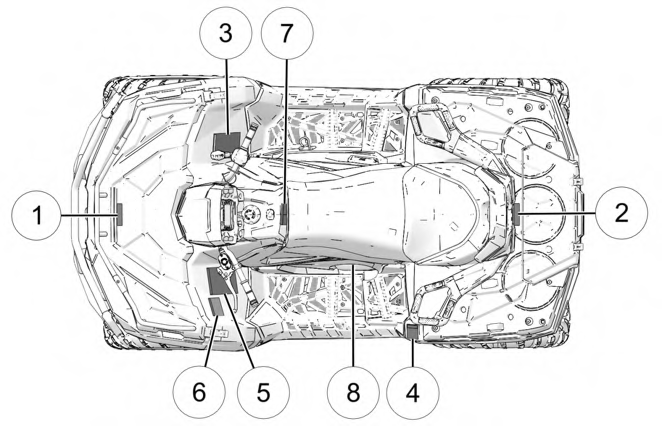 SPORTSMAN TOURING 570
q Front Rack / Container Warning
w Rear Rack Warning
e Passenger Safety Warning
r Tire Pressure / Load Warning
t General Warning
y Age 16 Warning
u Reverse Override / AWD Warning
i Clutch Cover Warning
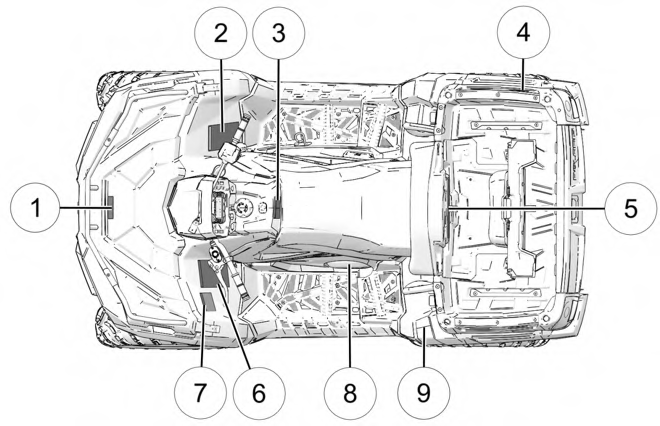 SPORTSMAN X2 570
q Front Rack / Container Warning
w Passenger Safety Warning
e Reverse Override / AWD Warning
r Fuel Transport Warning
t Passenger Warning
y General Warning
u Age 16 Warning
i Clutch Cover Warning
o Tire Pressure / Load Warning
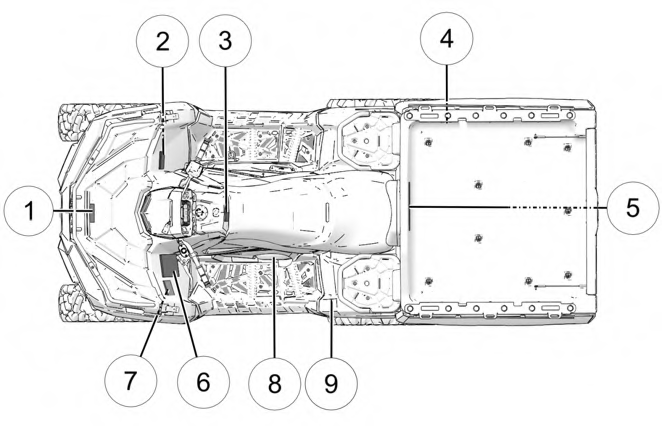 SPORTSMAN 6X6 570
q Front Rack / Container Warning
w Discretionary Warning
e Reverse Override / AWD Warning
r Fuel Transport Warning
t Passenger Warning
y General Warning
u Age 16 Warning
i Clutch Cover Warning
- Tire Pressure / Load Warning
FRONT RACK / CONTAINER WARNING
 WARNING
-
- DO NOT TOW FROM RACK OR BUMPER.
Vehicle damage or tipover may result causing severe injury or death. Tow only from tow hooks or hitch.
-
- Maximum Combined Front Rack and Container Load: 90 lbs (41 kg) Part Number: 7174201
REAR RACK WARNING (TOURING MODELS)
 WARNING
-
- DO NOT TOW FROM RACK OR BUMPER.
Vehicle damage or tipover may result causing severe injury or death. Tow only from tow hooks or hitch.
-
- Maximum Rack Loads:
- Front: 90 lbs (41 kg)
- Rear: 180 lbs (82 kg)
- Maximum Rack Loads:
Part Number: 7172572
PASSENGER SAFETY WARNING
 WARNING
PASSENGER SAFETY
To reduce the risk of SEVERE INJURY or DEATH NEVER CARRY MORE THAN ONE PASSENGER NEVER RIDE AFTER USING DRUGS OR ALCOHOL
NEVER carry a passenger too small to firmly plant feet on footrests and securely grasp hand holds.
THE PASSENGER MUST ALWAYS:
-
- use an approved helmet and protective gear
- securely grasp hand holds and plant feet firmly on footrests while seated in the passenger seat
- tell operator to slow down or stop if uncomfortable – get off and walk if conditions require
 WARNING
- Never operate this ATV on HILLS steeper than 15 degrees. To prevent overturn on hilly terrain, use throttle and brakes gradually, and shift weight uphill.
- REVERSE operation can be dangerous even at low speeds. Steering becomes difficult. To prevent loss of control, avoid sudden braking or sharp turns.
Part Number: 7186130
TIRE PRESSURE / LOAD WARNING (TOURING MODELS)
 WARNING
Improper tire pressure or overloading can cause loss of control. Loss of control can result in severe injury or death.
- Cold tire pressure:
- Front: 7.0 psi (48.2 kPa)
- Rear: 7.0 psi (48.2 kPa)
- Maximum weight capacity: 485 lbs (220 kg)
NEVER exceed 50 mph (80 kph) when rear cargo loads are above 75 lbs (34 kg) and/or front cargo loads are above 37 lbs (17 kg).
NEVER exceed 50 mph (80 kph) while carrying a passenger. Part Number: 7186143
TIRE PRESSURE / LOAD WARNING (X2 MODELS)
 WARNING
Improper tire pressure or overloading can cause loss of control. Loss of control can result in severe injury or death.
- Cold tire pressure:
- Front: 7.0 psi (48.3 kPa)
- Rear: 7.0 psi (48.3 kPa)
- Maximum weight capacity: 705 lbs. (320 kg)
NEVER exceed 50 mph (80 kph) when rear cargo loads are above 75 lbs (34 kg) and/or front cargo loads are above 37 lbs (17 kg).
NEVER exceed 50 mph (80 kph) while carrying a passenger.
NEVER exceed 10 mph (16 kph) when rear cargo loads are above 200 lbs (91 kg) and/or front cargo loads are 90 lbs (41 kg).
Part Number: 7301141
TIRE PRESSURE / LOAD WARNING (6X6 MODELS)
 WARNING
Improper tire pressure or overloading can cause loss of control. Loss of control can result in severe injury or death.
- Cold tire pressure:
- Front: 7.0 psi (48.3 kPa)
- Rear: 10.0 psi (68.9 kPa)
- Maximum weight capacity: 1115 lbs. (505.8 kg)
NEVER exceed 50 mph (80 kph) when rear cargo loads are above 75 lbs (34 kg) and/or front cargo loads are above 37 lbs (17 kg).
NEVER exceed 50 mph (80 kph) while carrying a passenger.
NEVER exceed 10 mph (16 kph) when rear cargo loads are above 200 lbs (91 kg) and/or front cargo loads are 90 lbs (41 kg).
Part Number: 7301142
AGE 16 WARNING
 WARNING
Operating this ATV if you are under the age of 16 increases the chances of severe injury or death to both operator and passenger.
NEVER operate this vehicle if you are under age 16. Part Number: 7186124
GENERAL WARNING
 WARNING
Improper use can result in SEVERE INJURY or DEATH
ALWAYS USE AN APPROVED HELMET AND PROTECTIVE GEAR FOR DRIVER AND PASSENGER
NEVER USE ON PUBLIC ROADS
NEVER CARRY MORE THAN 1 PASSENGER NEVER USE WITH DRUGS OR ALCOHOL
NEVER operate:
- without proper ATV training or instruction
- at speeds too fast for your skills or the conditions
- on public roads – a collision can occur with another vehicle
- with a passenger unless passenger seat is securely in place
THE OPERATOR MUST ALWAYS:
- use proper riding techniques to avoid overturns on hills and rough terrain and in turns
- avoid paved surfaces – pavement may seriously affect handling and control
- reduce speed and use extra caution at all times when carrying a passenger – dismount passenger when conditions require
- make sure passenger reads and understands this label and passenger safety label
Part Number: 7186137
REVERSE OVERRIDE / AWD WARNING
 WARNING
Improper use of override button can lead to loss of control resulting in severe injury or death. Do not activate override while throttle is engaged. Always apply throttle gradually, while in reverse.
 CAUTION
Do not push switch to engage 4X4 (AWD) if the rear wheels are spinning. This may cause severe drive shaft and clutch damage.
Part Number: 7195826
CLUTCH COVER WARNING
 WARNING
-
- Moving parts hazard under belt-clutch guard. To prevent serious injury, do not operate vehicle with guard removed.
- Do not modify engine or clutch. Doing so can cause part failure, possible imbalance, and excessive engine RPM, which can result in serious injury or death.
NO STEP
Part Number: 7180088
PASSENGER WARNING (X2 MODELS)
 WARNING
-
- Passengers can be thrown off. This can cause serious injury or death.
- Never carry passengers in cargo box.
 WARNING
Maximum Box Load: 400 lbs (181 kg) Part Number: 7301054
PASSENGER WARNING (6X6 MODELS)
 WARNING
- Passengers can be thrown off. This can cause serious injury or death.
- Never carry passengers in the cargo box.
 WARNING
Maximum Box Load: 800 lbs (363 kg) Part Number: 7301055
FUEL TRANSPORT WARNING

 WARNING
NEVER carry fuel or other flammable liquids on this vehicle.
Failure to follow this instruction could lead to serious burn injuries or death.
Part Number: 7186122
HITCH DECAL (TOURING AND X2 MODELS)
Trailer Maximum Weight: 1350 lbs (612 kg) on level ground Hitch Maximum Vertical Weight: 180 lbs (82 kg)
Part Number: 7300800
HITCH DECAL (6X6 MODELS)
Trailer Maximum Weight: 1500 lbs (680 kg) on level ground Hitch Maximum Vertical Weight: 180 lbs (82 kg)
Part Number: 7300801