
OPERATION
SAFE OPERATION PRACTICES

Failure to operate the vehicle properly can result in a collision, loss of control, accident or rollover, which may result in serious injury or death. Read and understand all safety warnings outlined in the safety section of this owner’s manual.
WARNING
- Complete the recommended safety training before operating this vehicle. Visit www.atvsafety.org for safety courses and riding tips. See page 11 for details.
- Do not allow anyone under 16 years of age to operate this vehicle. Do not allow anyone with cognitive or physical disabilities to operate this vehicle.
- Never carry a passenger on a 1-up ATV. Never carry more than one passenger on a 2-up ATV.
- Engine exhaust fumes are poisonous. Never start the engine or let it run in an enclosed area.
- Before operating, learn how to use the auxiliary brake for emergency situations (if service brakes become inoperable).
- Use caution and drive at reduced speeds in conditions of reduced visibility such as fog, rain and darkness. Clean headlights frequently and replace burned out headlamps promptly.
- Drive in a manner appropriate for your skills, your passenger’s skills (if you are operating a 2-up ATV), and operating conditions. Never operate at excessive speeds. Never attempt wheelies, jumps, or other stunts. Never remove your hands from the handlebars while operating, and always keep both feet on the footrests.
- Never consume alcohol or drugs before or while operating an ATV.
- Always use the size and type of tires specified for your vehicle. Always maintain proper tire pressure.
- Never operate a damaged ATV. After any overturn or accident, have a qualified service dealer inspect the entire machine for possible damage.
- Never operate the ATV on a frozen body of water unless you have independently verified that the ice is sufficiently thick to support the weight and moving force of the ATV, you and your cargo, together with any other vehicles in your party.
- Do not touch hot exhaust system components. Always keep combustible materials away from the exhaust system.
- Always remove the ignition key when the vehicle is not in use to prevent unauthorized use.
TRAIL ETIQUETTE
Always practice good etiquette when riding. Allow a safe distance between your vehicle and other vehicles operating in the same area. Communicate to oncoming operators by signaling the number of vehicles in your group. When stopping, move your vehicle to the edge of the trail as far as possible to allow others to pass safely.
KNOW YOUR RIDING AREA/TREAD LIGHTLYSM
Familiarize yourself with all laws and regulations concerning the operation of this vehicle in your area. Respect the environment in which you ride your vehicle.
Find out where the designated riding areas are by contacting your POLARIS dealer, a local riding club, or local officials.
Help keep our trails open for recreational vehicle use. As an off-road enthusiast, you represent the sport and can set a good example (or a poor example) for others to follow. Tread LightlySM. Operate with respect for the terrain, avoid littering, and always stay on the designated trails.
VEHICLE BREAK-IN PERIOD
The break-in period for your new POLARIS vehicle is the first 25 hours of operation, or the time it takes to use the first two tanks full of gasoline. No single action on your part is as important as a proper break-in period. Careful treatment of a new engine and drive components will result in more efficient performance and longer life for these components. Perform the following procedures carefully.
Excessive heat build-up during the first three hours of operation will damage close-fitted engine parts and drive components. Do not operate at full throttle or high speeds during the first three hours of use.
Use of any improper oils may cause serious engine damage. POLARIS PS-4 Full Synthetic 5W-50 4-Cycle Oil is specifically formulated for your 4-cycle engine.
NOTICE
ENGINE AND DRIVETRAIN BREAK-IN
-
- Fill the fuel tank with gasoline. Always exercise extreme caution whenever handling gasoline.
- Check the oil level. See the Oil Level Check section for reference. Add the recommended oil as needed to maintain the oil level in the safe operating range.
- Drive slowly at first. Select an open area that allows room to familiarize yourself with vehicle operation and handling.
- Avoid aggressive use of the brakes.
- Vary throttle positions. Do not operate at sustained idle.
- Pull only light loads.
- Perform regular checks on fluid levels, controls, and areas outlined in the pre-ride inspection checklist.
- During the break-in period, change both the engine oil and filter at 25 hours or 500 miles (800 km) (whichever comes first).
- During the break-in period, change the front gearcase fluid at 25 hours or 500 miles (800 km) (whichever comes first).
- During the break-in period, check the transmission fluid level at 25 hours or 500 miles (800 km) (whichever comes first).
BRAKE SYSTEM BREAK-IN
Apply only moderate braking force for the first 50 stops. Aggressive or overly forceful braking when the brake system is new could damage brake pads and rotors.
Perform the following steps on a new vehicle or anytime brake pads are replaced on the vehicle:
- In an appropriate riding area, safely slow the vehicle with moderate (70%) braking from 30 mph (50 km/h) down to 5 mph (8 km/h). Do not stop completely in order to keep air flowing through the brakes.
- Repeat for 10-20 cycles and let the brakes cool between each cycle by riding your vehicle approximately 0.25 miles (400 m).
- After you have completed all 20 cycles, ride the ATV for awhile to cool the braking system to avoid overheating the brakes.
- Stop the vehicle and put the transmission in PARK. DO NOT apply the temporary brake lock until the brake system has fully cooled.
PVT BREAK-IN (CLUTCHES / BELT)
A proper break-in of the clutches and drive belt will ensure a longer life and better performance. Break in the clutches and belt by operating at slower speeds during the break-in period as recommended. Pull only light loads. Avoid aggressive acceleration and high speed operation during the break-in period.
If a belt fails and you need to replace it, always clean all debris from the PVT intake and outlet duct, the clutch, and the engine components.
PRE-RIDE CHECKLIST
Failure to inspect and verify that the ATV is in safe operating condition before operating increases the risk of an accident. Always inspect the ATV before each use to make sure it’s in safe operating condition.
| ITEM | REMARKS | PAGE |
| Brake system/lever travel | Ensure proper operation. Inspect for adequate brake pad life. | page 46page 153 |
| Brake fluid | Ensure proper level | page 46page 49 |
| Auxiliary brake | Ensure proper operation | page 48 |
| Front suspension | Inspect | – |
| Rear suspension | Inspect | – |
| Steering | Ensure free operation | – |
| Tires | Inspect condition and pressure | page 168 |
| Wheels/fasteners | Inspect, ensure fastener tightness | page 172 |
| Fuel and oil | Ensure proper levels | page 136 |
| Coolant level | Ensure proper level | page 150 |
| Coolant hoses | Inspect for leaks | – |
| Throttle | Ensure proper operation | page 38 |
| Indicator lights/switches | Ensure operation | page 57 |
| Engine stop switch | Ensure proper operation | page 37 |
| Air filter, pre-filter | Inspect, clean | page 174 |
| Headlamp | Check operation | page 37 |
| Brake light/taillight | Check operation | – |
| Riding gear | Wear approved helmet, goggles, and protective clothing | page 11 |
| Winch (if equipped) | Inspect cable and switch | page 117 |
| Grass and leaves | Remove grass, leaves, foreign matter, and other flammable material or debris, especially near the exhaust system. | – |
DRIVING PROCEDURES
NEW OPERATOR DRIVING PROCEDURES
- Complete a certified safety training course. See the Safety Training section.
- Wear protective riding gear. See the Safe Riding Gear section.
- Perform the pre-ride inspection.
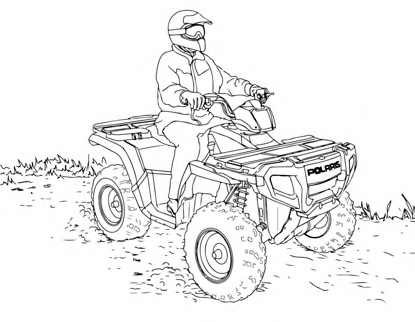 Place the transmission in PARK.
- Lock the temporary brake lock.
- Mount the vehicle from the left side.
- Sit upright with both feet on the footrests and both hands on the handlebars.
- Start the engine and allow it to warm up.
- Shift the transmission into gear.
- Check your surroundings and determine your path of travel.
- Release the temporary brake lock.
- Slowly depress the throttle with your right thumb and begin driving.
- Drive slowly. Practice maneuvering and using the throttle and brakes on level surfaces.
TURNING THE VEHICLE
Both rear wheels drive equally at all times. This means that the outside wheel must travel a greater distance than the inside wheel when turning, and the inside tire must slip traction slightly.
-
- Slow down.
- Never turn quickly when carrying cargo.
- Steer in the direction of the turn.
- Keep both feet on the footrests.
- Lean your upper body to the inside of the turn while supporting your weight on the outer footrest. This technique alters the balance of traction between the rear wheels, allowing the turn to be made smoothly. The same leaning technique should be used for turning in reverse.
- Practice making turns at slow speeds before attempting to turn at faster speeds.

Turning improperly can result in vehicle overturn. Never turn abruptly or at sharp angles. Never turn at high speeds.
WARNING
DRIVING ON SLIPPERY SURFACES
Whenever riding on slippery surfaces such as wet trails or loose gravel, or during freezing weather, follow these precautions:
- Do not operate on excessively rough, slippery or loose terrain.
- Slow down when entering slippery areas.
- Engage AWD before wheels begin to lose traction.
Severe damage to drive train may occur if the AWD is engaged while the wheels are spinning. Allow the rear wheels to stop spinning before engaging AWD, or engage AWD before wheels begin to lose traction.
NOTICE
- Maintain a high level of alertness, reading the trail and avoiding quick, sharp turns, which can cause skids.
- Never apply the brakes during a skid. Correct a skid by turning the handlebars in the direction of the skid and shifting your body weight forward.
DRIVING UPHILL
Braking and handling are greatly affected when operating in hilly terrain. Improper procedure could cause loss of control or overturn. Whenever traveling uphill, follow these precautions:
-
- Always engage ADC before ascending or descending a hill.
- Drive straight uphill.
- Avoid steep hills. Maximum incline is: 15°
- Always check the terrain carefully before ascending any hill.
- Never climb hills with excessively slippery or loose surfaces.
- Keep both feet on the footrests.
- Shift body weight uphill.
- Proceed at a steady rate of speed and throttle opening. Opening the throttle suddenly could cause the ATV to flip over backwards.
- Never go over the top of any hill at high speed. An obstacle, a sharp drop, or another vehicle or person could be on the other side of the hill.
- Remain alert and be prepared to take emergency action. This may include quick dismounting of the vehicle.
 DRIVING DOWNHILL
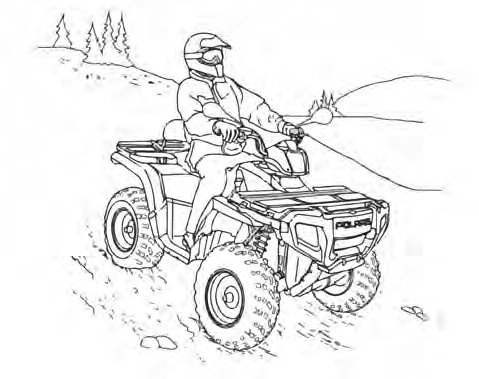
When driving downhill, follow these precautions:
- Always check the terrain carefully before descending a hill.
- Always engage ADC mode before ascending or descending a hill.
- Avoid steep hills. Maximum incline is 15°
- Always descend a hill with the transmission in forward gear. Do not descend a hill with the transmission in neutral.
- Slow down. Never travel down a hill at high speed.
- Drive straight downhill. Avoid traveling down a hill at an angle, which would cause the vehicle to lean sharply to one side.
- Shift body weight uphill.
- Apply the brakes slightly to aid in slowing. Applying the brakes too firmly may cause the rear wheels to lock, which could result in loss of control.
DRIVING ON A SIDEHILL (SIDEHILLING)
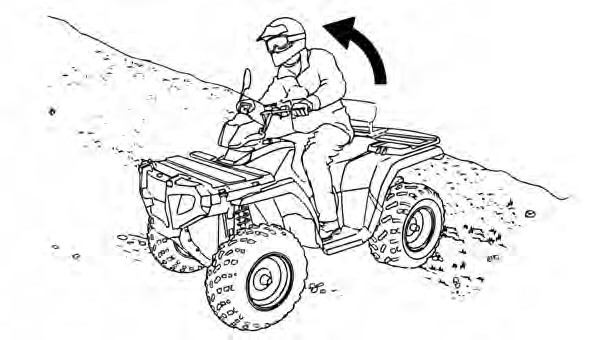
Driving on a sidehill is not recommended. Improper procedure could cause loss of control or overturn. Avoid crossing the side of any hill unless absolutely necessary.
If crossing a sidehill is unavoidable, follow these precautions:
-
- Slow down.
- Avoid crossing the side of a steep hill.
- Lean into the hill, transferring your upper body weight toward the hill while keeping your feet on the footrests.
- If the vehicle begins to tip, quickly turn the front wheel downhill, if possible, or dismount on the uphill side immediately!
TURNING AROUND ON A HILL (K-TURN)
If the vehicle stalls while climbing a hill, never back it down the hill! Use the K-turn to turn around.
- Stop and lock the temporary brake lock while keeping body weight uphill.
- Always engage AWD or ADC mode (if equipped) before ascending or descending a hill.
- Leave the transmission in forward and shut off the engine.
- Dismount on the uphill side of the vehicle, or on the left if the vehicle is pointing straight uphill.
- Staying uphill of the vehicle, turn the handlebars full left.
- While holding the brake lever, release the temporary brake lock and slowly allow the vehicle to roll around to your right until it’s pointing across the hill or slightly downward.
- Lock the temporary brake lock. Remount the vehicle from the uphill side, keeping body weight uphill. Start the engine with the transmission still in forward.
- Release the temporary brake lock and proceed slowly, controlling speed with the brake lever, until the vehicle is on more level ground.
DRIVING THROUGH WATER
Major engine damage can result if the vehicle is not thoroughly inspected after operation in water. Perform the services outlined in the Maintenance chapter. The following areas need special attention: engine oil, transmission fluid, demand drive fluid, and all grease fittings.
If the vehicle tips or overturns in water, or if the engine stops during or after operating in water, service is required before starting the engine. Your POLARIS dealer can provide this service. If it’s impossible to bring the vehicle in before starting the engine, perform the service outlined in the Vehicle Immersion section of this manual, and take the vehicle in for service at the first opportunity.
NOTICE
Your ATV can operate through water with a maximum recommended depth equal to the bottom of the footrests.
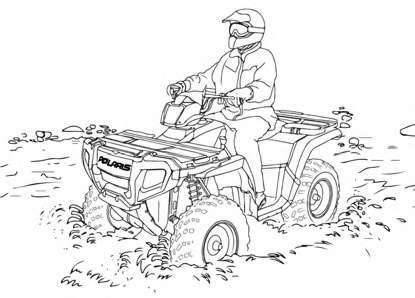 Follow these procedures when operating through water:
-
- Determine water depths and current before entering water.
- Choose a crossing where both banks have gradual inclines.
- Avoid operating through deep or fast-flowing water.
- After leaving water, test the brakes. Apply them lightly several times while driving slowly. The friction will help dry out the pads.
If it’s unavoidable to enter water deeper than the footrest level:
-
-
- Proceed slowly. Avoid rocks and obstacles.
- Balance your weight carefully. Avoid sudden movements.
- Maintain a steady rate of speed. Do not make sudden turns or stops. Do not make sudden throttle changes.
-
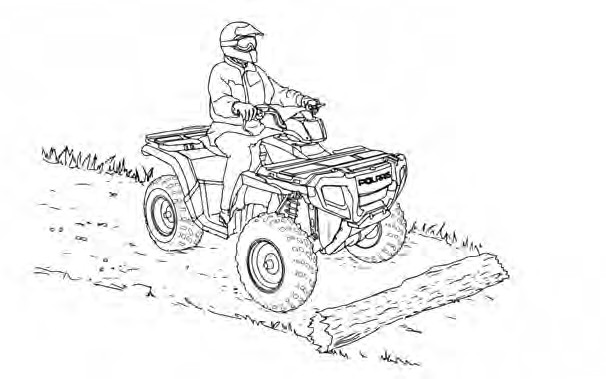 DRIVING OVER OBSTACLES
Follow these precautions when operating over obstacles:
- Always check for obstacles before operating in a new area.
- Look ahead and learn to read the terrain. Be constantly alert for hazards such as logs, rocks and low hanging branches.
- Travel slowly and use extra caution when operating on unfamiliar terrain. Not all obstacles are immediately visible.
- Never attempt to operate over large obstacles, such as rocks or fallen trees.
- If you are operating a 2-up ATV, always have the passenger dismount before you operate over an obstacle that could cause a fall from the vehicle or vehicle tipover.
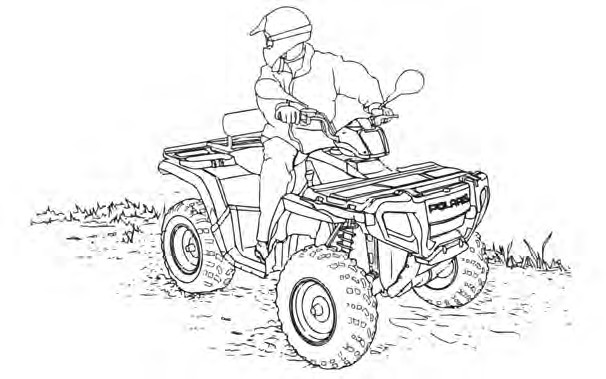 DRIVING IN REVERSE
Follow these precautions when operating in reverse:
-
- Always check for obstacles or people behind the vehicle.
- Always avoid backing downhill.
- Back slowly.
- Apply the brakes lightly for stopping.
- Avoid turning at sharp angles.
- Never open the throttle suddenly.
- Do not use the override switch unless additional wheel speed is required for vehicle movement. Use the override with caution as rearward vehicle speed is greatly increased. Do not operate at wide open throttle. Operate the throttle just enough to maintain a desired speed.
Excessive throttle operation while in the speed limit mode may cause fuel to build in the exhaust, resulting in engine popping and/or engine damage.
NOTICE
STARTING THE ENGINE
- Position the vehicle on a level surface outdoors or in a well- ventilated area.
- Place the transmission in PARK.
- Lock the temporary brake lock.
- Sit on the vehicle and move the engine stop switch to RUN.
Do not press the throttle while starting the engine.
NOTICE
- Turn the ignition key past the ON position to engage the starter. Activate the starter for a maximum of five seconds, releasing the key when the engine starts.
- If the engine does not start, return the key to the OFF position and wait five seconds before attempting to start again. Activate the starter for another five seconds if necessary. Repeat this procedure until the engine starts.
Operating the vehicle immediately after starting could cause engine damage. Allow the engine to warm up for several minutes before operating the vehicle.
NOTICE
COLD WEATHER OPERATION
If the vehicle is used year-round, check the oil level frequently. A rising oil level could indicate the accumulation of contaminates such as water or excess fuel in the bottom of the crankcase. Water in the bottom of the crankcase can lead to engine damage and must be drained. Water accumulation increases as outside temperature decreases.
STOPPING THE ENGINE
- Release the throttle completely and brake to a complete stop.
- Place the transmission in PARK.
- Turn the key to the OFF position.
- Slowly release the brake pedal and make sure the transmission is in PARK before exiting the vehicle.

A rolling vehicle can cause serious injury. Always place the transmission in PARK before stopping the engine.
WARNING
FUEL RECOMMENDATION
POLARIS recommends using fresh unleaded 87 octane TOP TIER DETERGENT GASOLINE® containing up to 10% ethanol purchased during the season of vehicle usage. This fuel will provide the best engine performance (starting, run quality, fuel economy, and power) and durability.
Octane Rating
POLARIS recommends using unleaded gasoline with a minimum 87 octane rating (R+M)/2 or 91 RON minimum. Using lower octane gasoline could result in engine damage.
Ethanol Content
POLARIS recommends gasoline containing up to 10% ethanol (E10). Higher levels of ethanol (ex. E15 and E85) could result in engine damage.
Detergent Gasoline
POLARIS recommends TOP TIER DETERGENT GASOLINE® to keep the engine cleaner by reducing carbon deposits, which will help maintain engine performance and durability. Refer to www.toptiergas.com for a list of TOP TIER DETERGENT GASOLINE® retailers. Alternatively, the logo shown below on the retailer’s fuel pump will confirm that TOP TIER DETERGENT GASOLINE® is being dispensed.

If TOP TIER DETERGENT GASOLINE® is not available, adding POLARIS Carbon Clean to the fuel tank at every oil change will help reduce carbon deposits.
Seasonal Blends
POLARIS recommends using gasoline that is purchased during the season the vehicle is being used, especially summer vs. winter. Between seasons, refineries typically change the gasoline blend to avoid temperature induced engine performance issues. Winter blend gasoline improves engine starting in cold weather and summer blend gasoline helps prevent vapor lock issues in hot weather.
PARKING THE VEHICLE
- Stop the vehicle on a level surface. When parking inside a garage or other structure, be sure that the structure is well ventilated and that the vehicle is not close to any source of flame or sparks, including any appliance with pilot lights.
- Place the transmission in PARK.
- Turn the engine off.
- Slowly release the brake pedal and make sure the transmission is in PARK before exiting the vehicle.
- Remove the ignition key to prevent unauthorized use.
PARKING ON AN INCLINE
Avoid parking on an incline if possible. If it’s unavoidable, follow these precautions:
- Place the transmission in PARK.
- Turn the engine off.
- Lock the temporary brake lock.
- Always block the rear wheels on the downhill side.
HAULING CARGO
CARGO WARNING
WARNING

Overloading the vehicle or carrying or towing cargo improperly can alter vehicle handling and may cause loss of control or brake instability, which can result in serious injury or death. Always follow these precautions when hauling cargo:
REDUCE SPEED AND ALLOW GREATER DISTANCES FOR BRAKING WHEN HAULING CARGO.
NEVER EXCEED THE MAXIMUM WEIGHT CAPACITY of the vehicle. When
determining the weight you are adding to the vehicle, include the weight of the operator, passenger (if you are operating a 2-up ATV), accessories, loads in the rack or box and the load on the trailer tongue. The combined weight of these items must not exceed the maximum weight capacity.
CARGO WEIGHT DISTRIBUTION should be 1/3 on the front rack and 2/3 on the rear rack. When operating over rough or hilly terrain, reduce speed and cargo to maintain stable driving conditions. Carrying loads on only one rack increases the possibility of vehicle overturn.
CARRY LOADS AS LOW ON THE RACKS AS POSSIBLE. Carrying loads
high on the racks raises the center of gravity of the vehicle and creates a less stable operating condition.
SECURE ALL LOADS BEFORE OPERATING. Unsecured loads can create unstable operating conditions, which could result in loss of control of the vehicle.

OPERATE ONLY WITH STABLE AND SAFELY ARRANGED LOADS. When
handling off-centered loads that cannot be centered, securely fasten the load and operate with extra caution. Always attach the tow load to the hitch point designated for your vehicle.
HEAVY LOADS CAN CAUSE BRAKING AND CONTROL PROBLEMS. Use
extreme caution when applying brakes with a loaded vehicle. Avoid terrain or situations that may require backing downhill.
USE EXTREME CAUTION when operating with loads that extend over the rack sides. Stability and maneuverability may be adversely affected, causing the vehicle to overturn.
DO NOT BLOCK THE FRONT HEADLIGHT BEAM when carrying loads on the front rack.
DO NOT TRAVEL FASTER THAN THE RECOMMENDED SPEEDS.
The vehicle should never exceed 10 mph (16 km/h) while towing a load on a level surface. Vehicle speed should never exceed 5 mph (8 km/h) when towing loads in rough terrain, while cornering, or while ascending or descending a hill.
WARNING
HAULING CARGO GUIDELINES
When hauling cargo, adhere to the following:
- Never exceed the weight capacities specified for your ATV on warning labels and in the specifications section of this manual.
- Always load a cargo box with the load as far forward as possible. Make sure the cargo box dump latch is securely latched before loading and operating. Unintentional dumping will result if weight is placed in the rear of the box and the latch is not secured.
No gasoline or other flammable fluids should be stored and / or transported in the cargo box.
IMPORTANT
- Models With Racks: Cargo weight should be evenly distributed with 1/3 on the front rack and 2/3 on the rear rack and mounted as low as possible.
- All Models: NEVER exceed 50 mph (80 km/h) when rear cargo loads are above 75 lb (34 kg) and/or front cargo loads are above 37 lb (17 kg). NEVER exceed 50 mph (80 km/h) while carrying a passenger.
6×6 Models: NEVER exceed 10 mph (16 km/h) when rear cargo loads are above 200 lb (91 kg) and/or front cargo loads are above 90 lb (45 kg).
- When operating over rough or hilly terrain, reduce speed and cargo weight to maintain stable driving conditions.
- Do not obstruct the headlight beam with cargo.
- Use low forward gear when hauling or towing heavy cargo.
- Always operate the vehicle with extreme caution whenever hauling or towing loads. Balance, handling and control may be affected.
TOWING LOADS
Always attach a towed load to the hitch point. Remove the hitch from the ATV when not towing a trailer. If towing a load, reduce rear rack cargo weight by the amount of tongue weight.
-
- The combination of rear rack cargo weight and tongue weight must not exceed the rear rack capacity.
- The total load (operator, accessories, cargo and weight on hitch) must not exceed the maximum weight capacity of the vehicle.
Using an improper hitch or exceeding the maximum tongue weight capacity can result in serious damage to the vehicle. Never install a hitch longer than 4 in (10 cm). Never install automotive accessories on your POLARIS ATV. Always install POLARIS-approved (or equivalent) accessories designed for ATV use.
NOTICE
MAXIMUM TOWING CAPACITIES
Do not exceed maximum towing capacities. Avoid towing on inclines.
| MODEL | CAPACITIES | FRONT HITCH | REAR HITCH |
| Touring and X2 Models | Maximum Towed Load(Level Ground) | N/A | 1350 lb (612 kg) |
| Maximum Vertical Hitch Weight | N/A | 180 lb (82 kg) | |
| 6×6 Models | Maximum Towed Load(Level Ground) | N/A | 1500 lb (680 kg) |
| Maximum Vertical Hitch Weight | N/A | 180 lb (82 kg) |
CARGO BOX DUMPING (IF EQUIPPED)

Operating with the cargo box in the raised position can cause serious injury and damage to the vehicle. The cargo box could close unexpectedly and injure the driver. The rear tires will also catch the rear of the bed, damaging the vehicle and creating hazardous driving conditions. Never operate this vehicle with the cargo box in the raised position.
WARNING
- Select a level site to dump the cargo box. Do not attempt to dump or unload the vehicle while parked on an incline.
- Place the transmission in PARK. Lock the temporary brake lock.
- Dismount the vehicle.
- Lower the tailgate.

If cargo weight is placed toward the rear of the cargo box, the load may dump unexpectedly and cause serious injury. When loading cargo, always position the weight as far forward and as low as possible.
WARNING
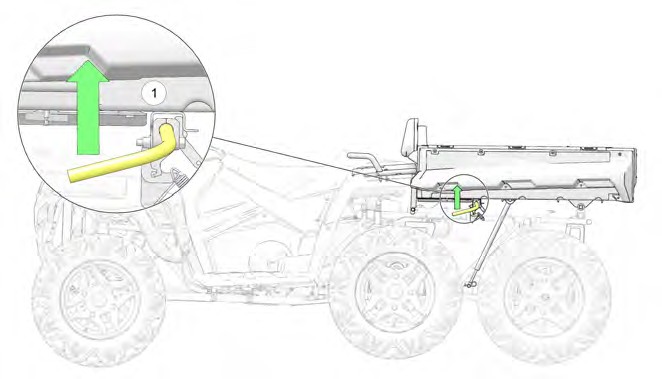
- Pull the cargo box release lever q upward.
- Lift the front of the cargo box and dump the cargo.
- Lower the cargo box and make sure the release latch is secured.

To prevent a crushing injury to hands and fingers, keep hands and fingers away from the lower front edge of the cargo box while lowering the box.
WARNING
- Secure the tailgate.
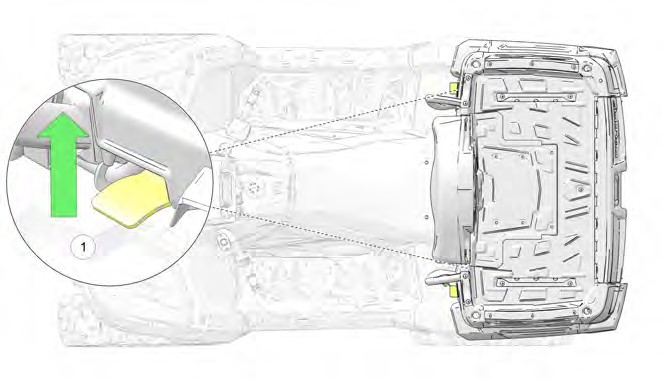 SPORTSMAN X2 570
SPORTSMAN 6X6 570
TOWING YOUR VEHICLE
If towing your vehicle is necessary, shift the transmission into neutral for better mobility and to prevent damage to the belt. Always attach the tow cable to the front tow loop of the disabled vehicle. A rider must be on board to steer the disabled vehicle while towing